
Infrastructure and connectivity
Fiber optics
Copper stops at 100 metres. Beyond that — from one building to another, across an industrial site, between two distant floors — fiber optics takes over, and brings complete immunity to electromagnetic interference along the way.
- RBQ licence 5828-4225-01
What a project covers
- Fiber pulling, indoors and between buildings
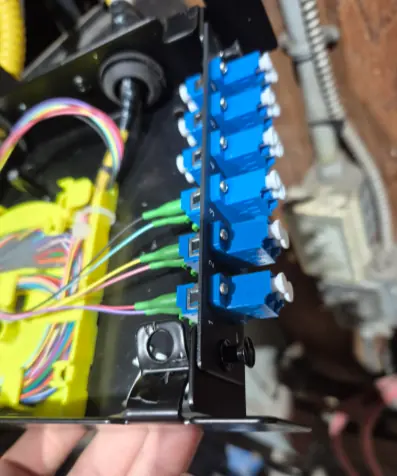
- Splicing and termination
- Connection to racks and active equipment
- Testing and documentation of the links
When fiber replaces copper
Three situations come up constantly. Long distances first: once a link exceeds copper’s standard reach, the question no longer arises.
Demanding environments next. On an industrial site — dust, humidity, temperature swings, motors and drives radiating away — fiber picks up none of it, where a twisted pair suffers electromagnetic interference.
Building-to-building links finally, where fiber also removes any electrical coupling between two separate earthing systems.
The same method as for copper
On-site survey, written quote, installation with testing, then a full documentation handover. Outdoor routes, wall penetrations and entry points are identified during the visit: those are what make a fiber quote vary twofold, not the price of the cable.
Where we work
Laval and Greater Montreal are the everyday. Fiber is also the trade that takes us furthest: a multi-site project took us as far as Toronto, and the company holds registered addresses in six Quebec regions, from the Laurentides to Nord-du-Québec.
That follows from the need itself: fiber gets pulled precisely when distances exceed what copper accepts, and when the buildings to be linked are not next door.
Frequently asked questions
When is fiber needed rather than copper?
As soon as the distance exceeds copper’s standard reach, whenever two buildings must be linked, and in environments with strong electromagnetic interference — typically an industrial site. Over short distances in an office, copper remains the sensible choice.
Are fiber links tested too?
Yes, on the same footing as copper: links are tested and the results handed over with drawings and labelling.