

Infrastructure and connectivity
Cat 6 and Cat 6A structured cabling
This is the foundation of the digital building: telephony, cameras, access control, wireless access points and workstations all run on top of it. Poorly installed or uncertified cabling costs you for ten years, and always needs replacing at the worst possible moment.
- RBQ licence 5828-4225-01
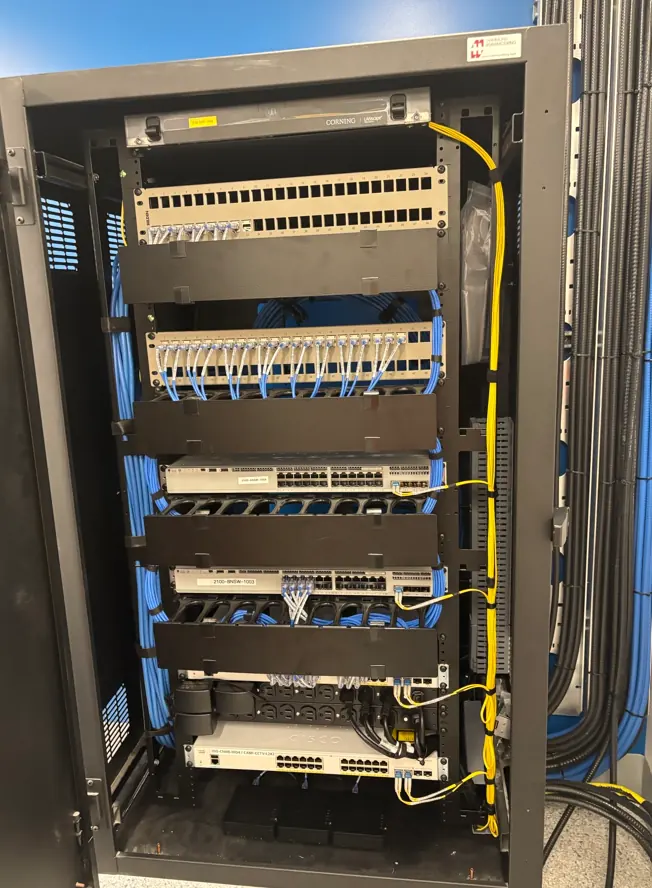
What an installation covers
- Cat 6 and Cat 6A copper structured cabling
- Mapping of cable routes and building constraints
- Fit-out of patching points and workstations
- Testing, certification and labelling of every link
- Drawings and documentation handed over
We install cabling from established manufacturers — Belden and Panduit — chosen to suit the need rather than out of loyalty to a brand.
Cat 6 or Cat 6A: what decides
Both carry 10 gigabits per second. Cat 6A sustains it over the full standard 100-metre length and resists interference between neighbouring cables better; Cat 6 carries the same rate over shorter distances.
The choice therefore rests on three things: the distances actually measured on site, cable tray density, and the intended lifespan of the installation. It is a survey decision, not a catalogue one.
A link that has not been tested is not a link delivered
Every link is tested and certified at the end of the work, and the results are handed over along with drawings and labelling. That is the documentation handover, the fourth of the five steps in our method, and the one most often skipped elsewhere.
Without those documents, the next job starts from nothing: routes have to be found again, outlets re-identified, and sometimes a ceiling opened to understand what was done. Documentation costs a day at handover and saves several on every subsequent visit.
In an occupied building
A good share of our work takes place in operating buildings: schedules, occupants and sensitive areas all have to be worked around. Those constraints are captured during the site visit and built into the quote, rather than discovered mid-project.
Aigle Info holds RBQ licence 5828-4225-01, exercised within the limits of its subcategories.
Where we work
Our crews work out of the Laval office on boulevard des Laurentides and cover Greater Montreal day to day. Cabling is the trade where proximity matters most: a link that needs redoing gets redone the next day, not the following week.
On planned assignments we work elsewhere in Quebec — the company holds registered addresses in six regions, from the Laurentides to the Côte-Nord — and in Ontario.
Frequently asked questions
What is the difference between Cat 6 and Cat 6A cabling?
Both carry 10 gigabits per second, but Cat 6A sustains it over the full standard 100-metre length and resists interference between neighbouring cables better. The choice depends on distances, cable tray density and the intended lifespan of the installation.
Are the installed links tested?
Yes. Every link is tested and certified, and the results are handed over along with drawings and labelling: that is the documentation handover, the fourth of the five steps in our method.
Can a floor be cabled without interrupting operations?
That is the usual case. Schedules, occupants and sensitive areas are captured during the site visit and built into the quote, along with the working windows that follow from them.